Page 11 of 29

Beckham leads Galaxy

Los Angeles Galaxy midfielder David Beckham (23) injures his back as he collides with New York Red Bulls midfielder/forward Dane Richards (19) and Dax McCarty, left, in the MLS Western Conference Semifinals game at the Home Depot Center in Carson, California on Nov. 3, 2011. The Galaxy won 2-1. UPI/Lori Shepler.

Is the David Beckham investment finally paying off?

David Beckham promised to repay the Los Angeles Galaxy’s faith and investment in him by finally ending the organization’s painful wait for an MLS Cup title.

The Galaxy have not tasted success since Beckham arrived in 2007 and now, in the final year of his lucrative contract, stand just two games from winning it all.

Beckham was outstanding Thursday night as the side overcame the New York Red Bulls 2-1 (3-1 on aggregate) in the second leg of the Western Conference semifinal, setting up Mike Magee for one goal and winning a penalty that was converted by Landon Donovan for the second.

If he can produce a similar effort at home to Real Salt Lake in Sunday’s winner-takes-all Western Conference final, it will put the Galaxy in a strong position to move into the title game.

It would be a great story.

Italy’s Mario Balotelli

Manchester City’s Mario Balotelli controls the ball during a training session at the club’s Carrington training complex in Manchester, northern England, November 1, 2011. City will play Villareal on Wednesday in their Champions League Group A soccer match in Spain. REUTERS/Nigel Roddis (BRITAIN – Tags: SPORT SOCCER)

Will Italy’s National Team ever be the same?

Here’s a great profile of Manchester City’s Mario Balotelli who also plays on Italy’s National Team.

Real Madrid defeats Lyon

Real Madrid’s Angel Di Maria (top) jumps over Olympique Lyon goalkeeper Hugo Lloris during their Champions League soccer match at the Gerland stadium in Lyon November 2, 2011. REUTERS/Emmanuel Foudrot(FRANCE – Tags: SPORT SOCCER)

Here’s a cool photo of Real Madrid’s Angel Di Maria jumping over Olympique Lyon goalkeeper Hugo Lloris during their Champions League soccer match at the Gerland stadium in Lyon. Real Madrid prevailed 2-0 to advance to the knockout stage.

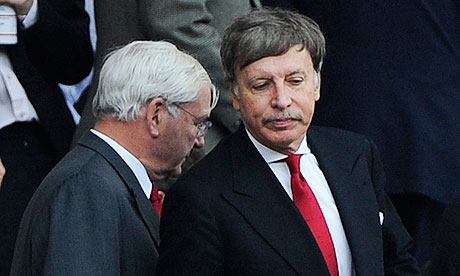
Are American owners good for Premiere League football?

Here’s an interesting article from The Guardian that highlights some different perspectives.

It was not what Arsenal supporters, or indeed any supporters of Premier League clubs, might have expected to hear in Stan Kroenke’s first interview in England. Kroenke, however, made little attempt to sugar the pill. What had the Glazer family, he wondered, done wrong at Manchester United? In his deep Missouri drawl, the largest shareholder at Arsenal made it sound like they had his admiration.

“What was so tough about the Glazers’ situation?” Kroenke said. “They won. And they have increased revenues by a huge amount. If I was a fan of that club, I would sit there and go, ‘Wow.’ Because how could you do it any better? That’s what I would say.”

It was put to Kroenke that United fans were deeply unhappy at how the American owners had taken money out of the club, following their heavily leveraged takeover. “But they still won,” Kroenke said. “We don’t need to get into an exchange here but I don’t know as a fan … how could you do it much better? They have increased massively. Some of their players have taken money out and maybe they haven’t performed.

“We have a whole different philosophy in the States but I think it’s time, maybe, for everybody to think a little bit and, maybe I’m saying too much but I think they ought to think a little bit about who invests in these clubs. What do you want for the long term?

The entire article is worth reading.

Challenge of World Cup preparations in Brazil

Issue like corruption, crime and poor infrastructure still present problems in Brazil, and many of these issues are getting attention in the lead-up to the 2014 World Cup:

For all those reasons, we should not overhype the economic effects of World Cup 2014. There will obviously be short-term gains for Brazilians working in construction and other industries, but the tournament will probably not deliver a permanent boost in income or employment levels. Indeed, many of the hugely expensive stadiums that are being built for the World Cup may sit empty and unused after the festivities are over, much like the stadiums that were constructed for the 2008 Summer Olympics in Beijing and the 2010 World Cup in South Africa.

Even if the 2014 tournament does produce the economic windfall that government officials are promising, World Cup preparations have drawn attention to embarrassing Brazilian corruption scandals and also reminded foreign observers that South America’s aspiring superpower suffers from poor infrastructure, excessive regulation, bureaucratic waste and inflexible labor markets.

Given that Brazilian politics is plagued by rampant corruption, it is not surprising that the Brazilian Football Confederation (CBF) is similarly afflicted. CBF president Ricardo Teixeira, who assumed that position way back in 1989, has been accused of massive embezzlement. These charges are receiving much greater scrutiny now that Teixeira and the CBF are playing such a big role in the World Cup planning, and they are currently being investigated by Brazilian federal police. (A decade ago, the general secretary of a Brazilian congressional commission declared that Teixeira ‘is directly responsible for creating an environment which is ripe for an administrative disaster.’)

Meanwhile, the Brazilian Supreme Federal Court is probing claims that Orlando Silva, a former senior government official, embezzled up to $23 million. On Oct. 26, Silva resigned from his job as Brazilian sports minister, becoming the fifth minister in President Dilma Rousseff’s government to leave office amid corruption allegations. (The Rousseff administration has been in power for less than a year.)

Brazil is on the verge of becoming a world power, but the Brazilians need to step up in this case.
« Older posts Newer posts »